Bladder & Pelvic Health
FemiCore Ingredients: The Full List, What Each One Does, and Interactions
HerWellReport is reader-supported: if you buy through a link on this page we may earn a commission at no extra cost to you. This is not medical advice — see our disclosure and medical disclaimer.
Our verdict
A sensible ingredient list for the urgency-and-infection side of bladder trouble, let down by one thing: not a single dose is published, so you cannot compare it to the amounts used in the studies.
Worth considering if
- Your main problem is urgency, frequency, night trips or repeat infections
- You have already tried the free things — pelvic floor work, bladder retraining, cutting evening irritants
- You will judge it on something you can count inside the 60 days
Skip it if
- You leak when you cough, sneeze or lift — nothing in a capsule rebuilds a pelvic floor
- You take metformin, a statin, a blood thinner or cyclosporine, or you are pregnant or breastfeeding
- You want to know exactly what dose you are taking — none are published
- Price at the time of writing
- $79 a bottle for two, $69 for three, $49 for six
- Guarantee
- 60 days from receipt, refund by email
- Tested by us
- No — we research products, we do not trial them
What we would do. Buy it for the cranberry-plus-probiotic combination, not for the minor ingredients. If you already take a cranberry extract and a Lactobacillus probiotic, you are most of the way there for less.
See today's price + 60-day guarantee → Read our full review first
Affiliate link — we may earn a commission at no extra cost to you. It does not change what we say here. We have not used or tested this product.
This page lists every ingredient in FemiCore as published on the official product pages, what each one is actually studied for, and — the part the sales page skips — which medications they can interact with. Every factual claim below is numbered and linked to its source at the foot of the page. For the full verdict on the product, see our complete FemiCore review.
The full list
FemiCore’s published formula contains nine ingredients: four botanicals/compounds — cranberry extract, bearberry (uva ursi), granular berberine, and mimosa pudica — plus five probiotic strains: Lactobacillus crispatus, L. acidophilus, L. plantarum, L. gasseri, and L. casei. Important caveat before the details: the maker does not publish per-ingredient dosages. That is legal rather than sinister — US labelling rules let a proprietary blend declare only its total weight, with components listed in order of predominance instead of by amount15 — but it does mean nothing below can be checked against the doses used in the research.
The botanicals
Cranberry extract
Full evidence entry for cranberry → (grade, interactions, primary source)
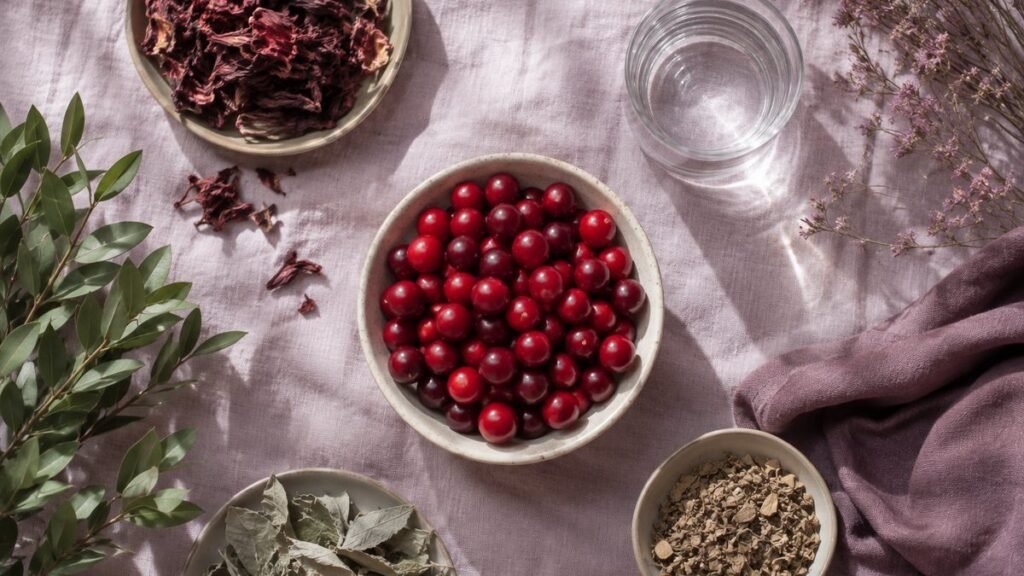
The workhorse of urinary-health supplements. Its proanthocyanidins (PACs) are thought to stop bacteria adhering to the bladder wall. The best current evidence is a 2023 Cochrane review, which found moderate-certainty evidence that cranberry products reduce symptomatic, culture-verified urinary tract infections in women with recurrent UTIs — while finding no benefit in several other groups, including pregnant women and elderly people in institutional care1. NCCIH puts the reduction at roughly 25% in that specific group2. Two things worth keeping straight. This is about preventing infections, not treating one you already have: the companion Cochrane review found no good-quality evidence that cranberry treats a UTI3. And no authoritative body evaluates cranberry as a treatment for incontinence at all — a leaking bladder and a bacterial infection are different problems. Cranberry extracts are usually standardised by PAC content, which FemiCore does not disclose; we could not find an authoritative source establishing a PAC dose–response for UTI prevention, so treat that standard as an industry convention rather than a proven threshold.
Bearberry (uva ursi)
Full evidence entry for uva ursi → (grade, interactions, primary source)
A traditional herbal urinary antiseptic. Its arbutin — at least 7% of the leaf material the European Medicines Agency assessed — splits into hydroquinone and glucose in the body5. The EMA’s herbal monograph permits it only as a traditional-use remedy for mild recurrent lower urinary tract infection in women, and is explicit that it should not be used for more than one week, that medical advice is needed if symptoms persist beyond four days, and that safety in pregnancy and breastfeeding has not been established4. Worth correcting a claim you will see repeated elsewhere: that one-week ceiling is usually blamed on hydroquinone toxicity, but the EMA’s own assessment report states free hydroquinone does not accumulate in humans, and attributes the limit to the tannin content’s effect on the gut5. The limit is real either way — and an ingredient capped at one week appearing in a formula sold in six-bottle bundles is a genuine question mark worth raising with a pharmacist.
Berberine
Full evidence entry for berberine → (grade, interactions, primary source)
A plant alkaloid with substantial research behind it — mostly on blood sugar and cholesterol, not bladders. Direct urinary evidence is thin; its likely role in this formula is antimicrobial. On liver safety it looks reassuring: the NIH’s LiverTox database rates it unlikely to cause clinically apparent liver injury9. Interactions are where it earns real attention, and the picture there is more specific than most articles admit — see the safety section below.
Mimosa pudica
Full evidence entry for mimosa → (grade, interactions, primary source)
The “sensitive plant”, used in traditional medicine and marketed in supplements mostly for gut claims. Its urinary evidence base is preclinical: what exists is animal work, such as a rat study of the root extract’s diuretic activity14. We found no human trial of Mimosa pudica for any bladder or urinary indication. It is the thinnest-evidenced ingredient in the formula, and it is not close.
The five probiotic strains
Two separate things get blurred in marketing for products like this, so keep them apart. The microbiome science is solid. Urine is not sterile: enhanced culture techniques grew bacteria from 52 of 65 adult female bladder samples that standard culture had reported as no growth10, and female urinary microbiomes are frequently dominated by Lactobacillus — L. crispatus in particular11. That makes the strain selection here rational rather than random.
The clinical benefit is a different question, and it is not established. A Cochrane review of nine trials covering 735 participants found no significant reduction in urinary tract infections from probiotics compared with placebo or no treatment, with a high risk of bias across the studies12. Probiotic effects are also strain-specific13 — results from one strain do not transfer to another. And without CFU counts, which FemiCore does not publish, nobody outside the company can verify this formula delivers what any study used. Promising biology, unproven product.
Interactions and safety — read this part
Berberine is the one to raise with a pharmacist, but the list you will see repeated elsewhere is not all equally evidenced, and the difference matters. A 2026 review that graded the evidence found cyclosporine is the well-documented interaction: in renal transplant recipients, berberine raised cyclosporin A trough concentrations by roughly 89%7. The metformin signal comes from a human study of goldenseal extract, which reduced metformin levels by about 25% — so the plausible risk is losing blood-sugar control, not the additive hypoglycaemia usually described68. Interactions with statins and blood thinners are widely repeated, but that same graded review found no human clinical data for either; both rest on berberine’s effect on liver enzymes in the lab6. That makes them a reason to check, not a documented interaction — and we would rather tell you that than pad the list. Berberine should be avoided in pregnancy and breastfeeding: NCCIH warns the compound can be harmful to newborns8.
Uva ursi is one-week-only under the EMA monograph, not recommended under 18, and not established as safe in pregnancy or breastfeeding4. Concentrated cranberry is routinely listed as interacting with warfarin; NCCIH describes that evidence as conflicting2, so treat it as a precaution worth mentioning rather than a settled fact.
If you take any prescription medication — especially for diabetes, cholesterol, blood clotting, or after a transplant — show this ingredient list to your doctor or pharmacist before ordering. Five minutes of their time beats a bad interaction.
One piece of context applies to every product on this shelf, not just this one: dietary supplements are not approved by the FDA for safety or effectiveness before they go on sale. The manufacturer is responsible for substantiating its own claims, and the FDA generally has to demonstrate a marketed product is unsafe in order to act against it16. That is the regulatory baseline, not an accusation about FemiCore.
HerWellReport verdict
- The formula
- Nine ingredients: cranberry extract, bearberry (uva ursi), granular berberine, mimosa pudica, and five Lactobacillus strains — crispatus, acidophilus, plantarum, gasseri, casei.
- What it targets
- The bacterial and irritation side of bladder trouble, not the muscle side.
- Strongest ingredient evidence
- Cranberry, for preventing recurrent UTIs in women prone to them — moderate certainty, and about infection rather than leaking.
- Weakest
- Mimosa pudica. The urinary evidence is animal studies; we found no human trial for any bladder indication.
- The gap
- No dosages are published anywhere — not on the label images, not on either official page. Ingredient research is meaningless if the amount in the capsule is a fraction of what was studied.
- Must check
- Berberine’s documented human interaction is with cyclosporine. The metformin signal points to reduced blood-sugar control. Statin and blood-thinner interactions are theoretical, not demonstrated in people. Avoid berberine in pregnancy. Uva ursi is capped at one week under the EMA monograph. Cranberry–warfarin evidence is conflicting.
- Ask a pharmacist
- Take the ingredient list in. It costs nothing and takes five minutes — particularly worth it if you take anything regularly.
Check current pricing on the official site →
Affiliate link: we may earn a commission at no additional cost to you. We have not used this product and do not claim to have tested it.
Those interactions are the reason we will not tell you that plant-based means consequence-free. The full trade-off, set against what a prescription actually does, is in bladder supplements versus prescription medication.
Keep researching
- The complete FemiCore review
- Does FemiCore work? The evidence, graded
- What FemiCore really costs and where to buy it
- How the FemiCore Guarantee Actually Works
- Utiva Cranberry PACs Review: Does the Dose Match?
- FemiCore vs Buying the Ingredients Separately
- FemiCore vs AZO Bladder Control: Ingredients, Price and Guarantee Compared
- Cystex Review: What’s Actually in the Cranberry Liquid
- Urox Review: The Trial Behind It, and the Hidden Dose
These interactions are not unique to this product. For the whole category in one place — uva ursi’s one-week limit, berberine’s effect on how your body clears other medicines, and the magnesium timing problem with certain antibiotics — see our reference on bladder supplement side effects and drug interactions.
Sources
Every source below was opened and checked. Where the evidence is weaker than the marketing implies, we have said so in the text rather than burying it down here.
- Williams G, Stothart CI, Hahn D, et al. Cranberries for preventing urinary tract infections. Cochrane Database of Systematic Reviews, 2023. cochrane.org
- Cranberry: Usefulness and Safety. National Center for Complementary and Integrative Health, NIH, 2024. nccih.nih.gov
- Jepson RG, Mihaljevic L, Craig JC. Cranberries for treating urinary tract infections. Cochrane Database of Systematic Reviews, 2023. cochrane.org
- European Union herbal monograph on Arctostaphylos uva-ursi (L.) Spreng., folium. Committee on Herbal Medicinal Products, European Medicines Agency, 2018. ema.europa.eu (PDF)
- Assessment report on Arctostaphylos uva-ursi (L.) Spreng., folium. Committee on Herbal Medicinal Products, European Medicines Agency, 2018. ema.europa.eu (PDF)
- Berberine–Drug Interactions: Mechanisms, Clinical Relevance and Risk Stratification — A Narrative Review. Pharmaceuticals, 2026. mdpi.com
- Wu X, Li Q, Xin H, Yu A, Zhong M. Effects of berberine on the blood concentration of cyclosporin A in renal transplanted recipients. European Journal of Clinical Pharmacology, 2005. link.springer.com
- Goldenseal: Usefulness and Safety. National Center for Complementary and Integrative Health, NIH, 2025. nccih.nih.gov
- Berberine. LiverTox: Clinical and Research Information on Drug-Induced Liver Injury. NIDDK / NCBI Bookshelf, 2020. ncbi.nlm.nih.gov
- Hilt EE, McKinley K, Pearce MM, et al. Urine Is Not Sterile: Use of Enhanced Urine Culture Techniques To Detect Resident Bacterial Flora in the Adult Female Bladder. Journal of Clinical Microbiology, 2014. journals.asm.org
- Neugent ML, Hulyalkar NV, Nguyen VH, Zimmern PE, De Nisco NJ. Advances in Understanding the Human Urinary Microbiome and Its Potential Role in Urinary Tract Infection. mBio, 2020. journals.asm.org
- Schwenger EM, Tejani AM, Loewen PS. Probiotics for preventing urinary tract infections in adults and children. Cochrane Database of Systematic Reviews, 2015. cochrane.org
- Probiotics: What You Need To Know. National Center for Complementary and Integrative Health, NIH, 2019. nccih.nih.gov
- Kalabharathi HL, et al. Diuretic Activity of Ethanolic Root Extract of Mimosa Pudica in Albino Rats. Journal of Clinical and Diagnostic Research, 2015. doaj.org
- Dietary Supplement Labeling Guide: Chapter IV. Nutrition Labeling. U.S. Food and Drug Administration, 2005. fda.gov
- Dietary Supplements: What You Need to Know. Office of Dietary Supplements, NIH, 2020. ods.od.nih.gov
Last checked August 2026. Sources are linked in full so you can read them yourself — we would rather you did.